
Intellectual Frontiers Press Fieldbooks
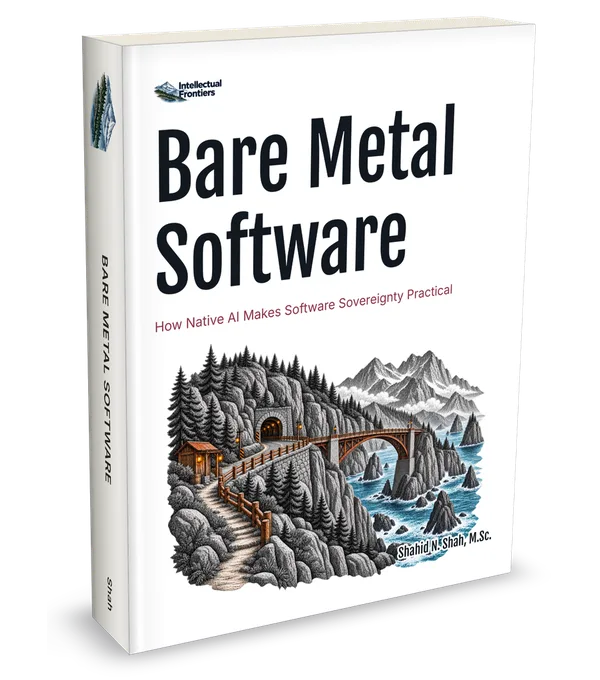
Bare Metal Software
How Native AI Makes Software Sovereignty Practical
When AI maintains the code, dependencies become a choice again.
Software stacks grew taller because human developers needed abstractions, frameworks, libraries, SDKs, and managed services to make difficult work practical. Native AI changes that tradeoff.
Forthcoming. The book is in review.
AI can write more code. That changes which layers software still needs.
Bare Metal Software starts with a simple rule: use the protocol directly when the protocol is simpler than the abstraction around it. It then asks a larger question: can one engineer or a tiny team maintain production software mainly through durable specifications and an agentic coding harness, letting Native AI own the implementation? HTML, HTTP, SQL, SMTP, FHIR, and other stable protocols can become cleaner seams for that model than layers built mainly to make those protocols easier for humans to program.
The goal is Software Sovereignty, and it does not require zero dependencies. It means fewer accidental obligations, clearer protocol boundaries, portable data, replaceable services, and systems that keep doing critical work when outside dependencies change or disappear.
Protocol first. Depend only when the dependency is simpler than what it hides.
What you will be able to do
- decide when a protocol is simpler than the library that wraps it;
- use HTML, HTTP, SQL, SMTP, FHIR, and native platform capabilities directly when they reduce lifetime obligation;
- know when mature libraries, frameworks, and security primitives are the simpler choice;
- build web, mobile, desktop, edge, data, and infrastructure systems for an AI-maintained future;
- move brownfield systems toward sovereignty one protocol boundary at a time;
- make specifications and tests the durable record that generated implementation is checked against;
- use Spec Kit, OpenSpec, Claude Code-style harnesses, or equivalent tools without turning the engineering process into another platform stack; and
- run a practical protocol-first Bare Metal Engineering Review.
The premise
Software stacks grew taller because human developers needed abstractions, frameworks, libraries, SDKs, and managed services to make difficult work practical. Native AI changes that tradeoff.