
Intellectual Frontiers Press Fieldbooks
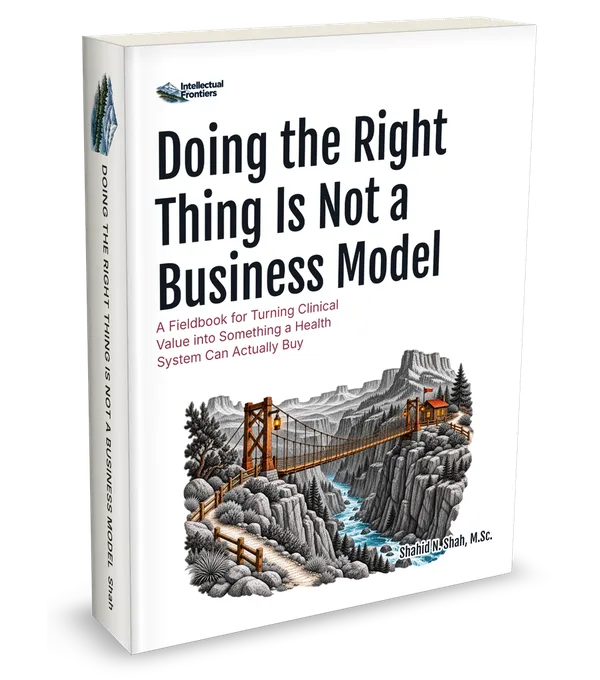
Doing the Right Thing Is Not a Business Model
A Fieldbook for Turning Clinical Value into Something a Health System Can Actually Buy
If this is the right thing to do, who has an economic and organizational reason to make it happen?
“There’s no business model in healthcare to do the right thing” contains both frustration and a research question. A product can be clinically effective, FDA cleared, physician-loved, and pilot-proven, and still have no path to a purchase, because the person who benefits is rarely the person who pays, the person who pays rarely controls the budget, and there is no single customer inside “the hospital.”
Forthcoming. The book is in review.
A product that works still needs an organization with a budget and a reason to buy it.
This fieldbook is about the missing half of healthcare entrepreneurship. Proving the product works is the first half. The second is finding which specific organization, role, and budget has an economic and institutional reason to buy it. The book develops the Clinical-to-Cash Chain, the Healthcare Buyer Map, the Right Thing Test, the Healthcare Opportunity Atlas built from public CMS data, and the Buying Thesis Six-Pager, then tests them against composite cases, including a chapter on VA and DoD, where mission, acquisition, and lifecycle constraints remove the reimbursement assumptions most healthcare startups depend on.
The goal is to give clinically valuable innovation a better chance of being adopted by the institutions that have to buy it, not to make founders cynical about healthcare.
Doing the right thing is not enough. You have to make the right thing buyable.
What you will be able to do
- replace the single “customer” with a real Healthcare Buyer Map;
- trace the Clinical-to-Cash Chain from FDA clearance through coding, coverage, and payment to an actual buyer;
- use public CMS utilization and payment data to find where real economic activity already exists;
- design a pilot backward from the purchase order instead of backward from a success story;
- diagnose exactly which link is missing when “there’s no business model” turns out to be true; and
- write a six-page buying thesis that holds up under the questions a CFO will ask.
The premise
“There's no business model in healthcare to do the right thing” is not a complaint. It is a research question. A product can be clinically effective, FDA cleared, physician-loved, and pilot-proven, and still have no institutional path to a purchase, because the person who benefits is rarely the person who pays, the person who pays rarely controls the budget, and “the hospital” is never actually the customer.