
Intellectual Frontiers Press
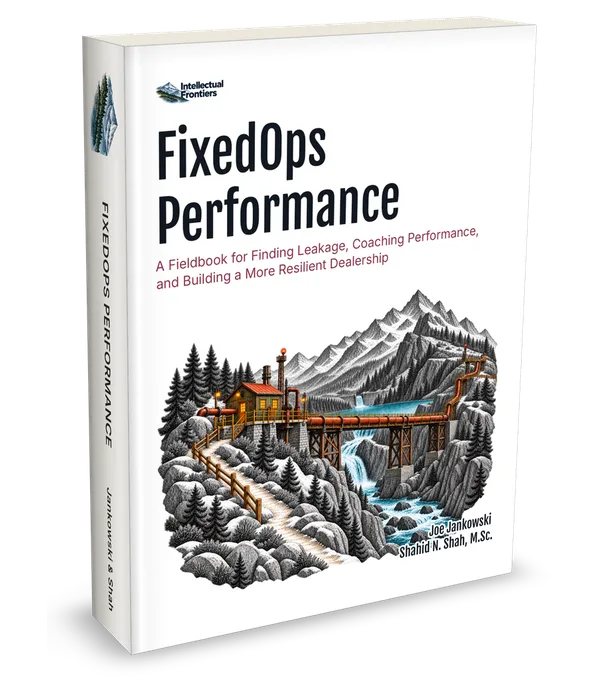
FixedOps Performance
A Fieldbook for Finding Leakage, Coaching Performance, and Building a More Resilient Dealership
Profit follows what a fixed operations department does on every repair order.
Most fixed operations problems do not arrive as large, obvious failures. They arrive as small, repeated variances: a discount here, two-tenths of an hour there, a technician waiting on a part, an advisor who presents some recommendations but not others.
Forthcoming. The book is in review.
Nothing in a fixed operations department sets profit directly, so this fieldbook shows how to find where it leaks before the monthly statement does.
FixedOps Performance is a working fieldbook for dealer principals, general managers, fixed operations directors, and service managers: two core frameworks (the FixedOps Performance Loop and Management at the Gap), the Leakage Map, the Variance Ladder, and a full ninety-day diagnostic-and-improvement playbook, worked through real numbers, real dispatch boards, real pay plans, and nine composite operator cases drawn from situations encountered, observed, or learned from over the years.
The book is quantitative by design and scale-aware throughout: what changes at one rooftop, in a small group, and across a large dealer group is never treated as the same advice given three times. A number is useful only when it connects to a decision, behavior, process, or constraint.
The financial statement is an autopsy. Management happens at the gap, before the numbers ever get there.
What you will be able to do
- run the FixedOps Performance Loop and Management at the Gap on any metric that has moved
- sort real leakage into the eight categories of the Leakage Map before you spend money on symptoms
- drill any groupwide variance down to the one RO line that explains it
- build a technician capacity waterfall that separates system loss from employee performance
- coach the behavior behind a ratio instead of the ratio itself
- design a pay plan that pays for the work you want done
- run a full ninety-day diagnostic and improvement plan, from baseline to institutionalized habit
- know what changes, and what shouldn't, at one rooftop, a small group, and a large dealer group
The premise
Most fixed operations problems do not arrive as large, obvious failures. They arrive as small, repeated variances: a discount here, two-tenths of an hour there, a technician waiting on a part, an advisor who presents some recommendations but not others. Individually, none of that looks like a crisis. In aggregate, it is the operating economics of the department.