
Intellectual Frontiers Press Fieldbooks
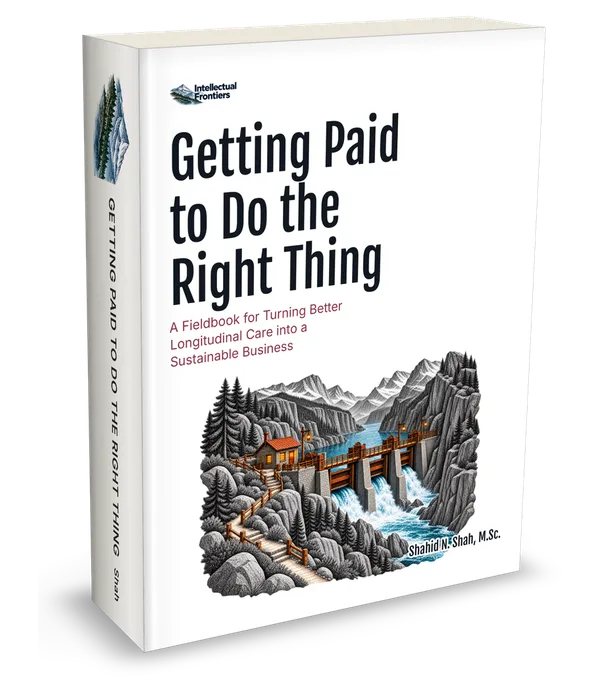
Getting Paid to Do the Right Thing
A Fieldbook for Turning Better Longitudinal Care into a Sustainable Business
Medicare already pays for more of this care than most practices collect. The practice has to build the operation that earns the payment.
American healthcare is accused of paying only for sickness and visits, and the charge is mostly fair. It is also incomplete. Medicare now pays for chronic care management, transitions after discharge, remote monitoring, behavioral health integration, illness navigation, caregiver training, advance care planning, and monthly advanced primary care bundles. Most practices collect a small fraction of it, because the administrative work of earning the payment takes more staff time than the payment covers.
Forthcoming. The book is in review; its companion and tools are open now.
Medicare already pays for the care. Most practices haven’t built the operation that earns the payment.
This fieldbook is the operating manual for closing that gap. It introduces the Attention Loop, the Capture Ladder, the Administrative Denominator, the Care-Delivery Operating System, and Practice Math, and works each one through the same practices month after month: a three-physician primary care office, a cardiology group whose monitoring program sent its nurses far more readings than they could act on, an endocrine practice that enrolled six hundred patients in eight weeks and shut the program down fourteen months later, and a health system that built a care-management department that cost more than it collected.
The goal is an operation where better care pays for the people and software that make it repeatable, and where a service that isn’t helping gets stopped.
Machines remember. Humans decide.
What you will be able to do
- find the between-visit care Medicare already pays for, grouped by the patient problem it solves;
- run the Capture Ladder from eligible to helped and fix the rung where your patients actually fall off;
- measure admin minutes per patient-month and cut them without cutting care;
- decide what software should remember, what AI should draft, and what only a clinician should decide;
- model any program at low, base, and high scenarios before you hire anyone; and
- launch with one program and one cohort, and scale only when the operation can prove it works.
The premise
American healthcare is accused of paying only for sickness and visits, and the charge is mostly fair. It is also incomplete. Medicare now pays for chronic care management, transitions after discharge, remote monitoring, behavioral health integration, illness navigation, caregiver training, advance care planning, and monthly advanced primary care bundles. Most practices collect a small fraction of it, because the administrative work of earning that payment costs more than the payment itself.