
Intellectual Frontiers Press Fieldbooks
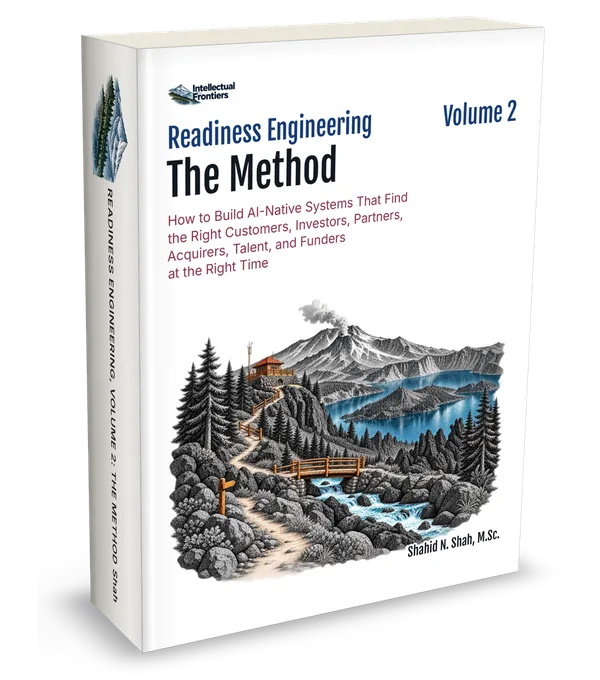
The Method
How to Build AI-Native Systems That Find the Right Customers, Investors, Partners, Acquirers, Talent, and Funders at the Right Time
A readiness system tells you who can act, why now, and what should happen next.
Most business development starts with a list of names that look right. Customers, investors, partners, acquirers, candidates, and grant programs all get the same treatment. Find people who match a profile, contact as many as possible, and wait for timing to work out. A good match still has to have the money, the authority, the mandate, the access, and the reason to act now.
Forthcoming. The book is in review.
A good fit doesn't mean a counterparty is ready. A counterparty can fit perfectly and still be unable to act, and the work is finding out which, with evidence.
Readiness Engineering is a way to build that judgment into a working system. One engineer and one domain operator build an AI Workforce in a Git repository. It records what outcome matters, who could produce it, what evidence shows they can act now, what should happen next, and what happened after the team acted. Every correction becomes a rule the system keeps.
This volume lays out the method that doesn't change with the tools. It applies one architecture to six kinds of transaction (customers, capital, partners, acquirers, talent, and grants), with the specifications, readiness states, Actionboards, audits, and Crawl / Walk / Run gates a team needs to design its first workforce. The volumes on building and running a workforce use current tools.
What you will be able to do
- define an outcome and the counterparties who could plausibly produce it;
- separate structural fit from readiness, timing, authority, and access;
- capture signals and evidence with provenance and a freshness date;
- design small, ethical probes that produce new evidence about the market;
- move explicit readiness states instead of trusting a single lead score;
- build an Actionboard that shows outcomes rather than activity;
- simulate the operator, then hand off through Crawl, Walk, and Run; and
- apply the same machinery to customers, investors, partners, acquirers, talent, and funders.