
Intellectual Frontiers Press
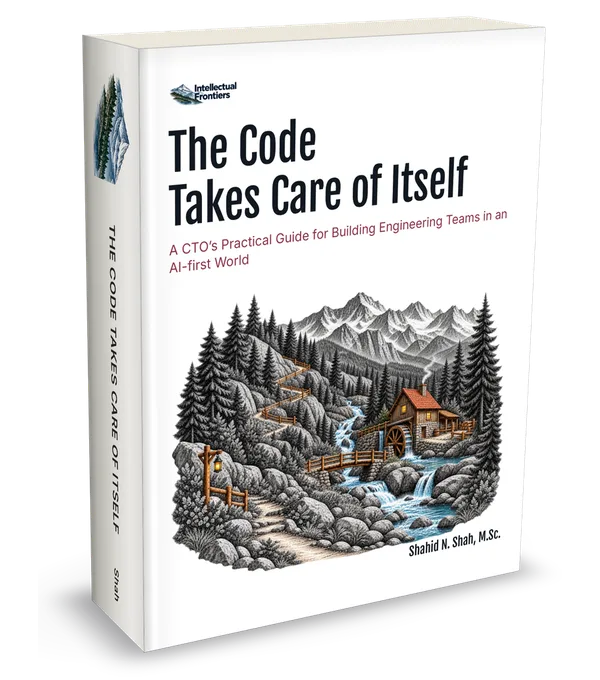
The Code Takes Care of Itself
A CTO’s Practical Guide for Building Engineering Teams in an AI-first World
How to build high performance teams the way the best athletic club coaches do.
AI didn’t make the CTO’s job easier. It moved the bottleneck. When every competitor can use the same AI models and technology stack, producing code is no longer the scarce advantage it once was. Execution gets faster and cheaper, but judgment, coordination, integration, validation, and accountability do not. The equipment no longer decides who wins. What decides it is the advantage your company already owns. This book calls that Native Alpha, and it teaches the discipline of chasing it.
Early access. The book is in review, and we send an early copy to whoever asks; its companion and tools are open now.
AI gives every competitor the same tools. The CTO’s job is to build a team that wins with them.
The Code Takes Care of Itself treats the CTO’s job the way an athletic club treats its head coach. A head coach doesn’t need to be the team’s best quarterback, and a CTO doesn’t need to be the organization’s best programmer. The job is to put people in the right positions, design the plays, prepare the team for what can’t be predicted, install a Standard of Performance, and make sure that standard holds under pressure, even when the CTO is not in the room.
The title carries two meanings. One is the code computers run, which AI can now produce in huge volume. The other is the code an organization lives by: its operating principles, standards, judgment, decision rules, and shared understanding of what “good” looks like. The first kind takes care of itself only after the CTO has built the second kind on purpose.
The CTO's job was never to be the best engineer in the building. It was to make sure the building did not need one.
What you will be able to do
- Install and defend a Standard of Performance in your first ninety days
- Chase Native Alpha: find the advantage only your company owns, and aim abundant AI capability at it
- Position specialists, including humans and AI agents, so their strengths reinforce one another
- Staff the seams and positions where standards must hold with nobody watching
- Tell Legacy Time from AI Time, and pay down Decision Debt
- Practice Completion Engineering: what AI makes cheap, what it makes scarce
- Grow leaders who don’t wait for you and a C-suite that reads engineering health
The premise
A contrarian, practical leadership book for the technologist who was promoted because they were the best engineer in the room, and is now discovering that the same instinct can make them the organization's most expensive bottleneck.
Who it is for
Primary readers
- New CTOs who need a first-90-days operating model rather than a catalog of technologies
- Fractional and interim CTOs establishing standards and trust without positional permanence
- VPs and Heads of Engineering moving to company-wide technology accountability
- Founder-CTOs deciding when the player-coach model has become a bottleneck
Also for
- CEOs, founders, and board members who need a concrete way to evaluate and support a CTO
- Product, security, data, and operations leaders who depend on technology but do not report to it
- Engineering directors and staff-plus engineers weighing the executive path
- Executive coaches, leadership programs, and operating teams developing technology leaders
Inside the book
Part I: Establishing the Standard of Performance
- The CTO as Athletic Club Coach
- Knowing the Game Before You Call the Plays
- How to Find Out What Business You're In
- Creating Standards and Sustaining Performance
Part II: Defining Your Playbook
- The Lineage: Skunk Works, the Algorithm, and Why Playbooks Win
- Developing and Implementing the Playbook
- Creating an Adaptable Playbook
Part III: Leadership in Technology Teams
- Building Your Team: Drafting and Developing Talent
- Putting Your Players in Position to Succeed
- Leading through Adversity: Narration Is the Job
Part IV: Execution and Performance
- The Role of Discipline: Enforcing Standards without Micromanaging
- Communicating the Strategy, in Both Directions
- The Instrument Panel: Teaching the C-Suite to Judge Engineering Health
- Managing Up, Down, and Sideways
Part V: Scaling Excellence
- Building for Growth: Scaling Technology and Teams
- Aligning Architecture and Infrastructure with Medium-Term Business Needs
- Leading with Flexibility: The Power of Late-Binding Decisions
- There Are No Solutions, Only Tradeoffs
Part VI: Long-Term Impact
- Completion Engineering: What AI Makes Cheap, and What It Makes Scarce
- Building Leaders Who Don't Wait for You
- Leaving a Legacy of Customer-Centric Leadership
Part VII: The Economics of the Playbook
- Capabilities, Not Tickets: Prioritizing by Economics
- Sweating the Details: Why Judgment Requires Direct Contact
Frameworks the book teaches
- The Master Orchestrator The CTO creates direction, developed judgment, and a compounding standard rather than trying to remain the best player at every position.
- AI Time versus Legacy Time Markets and tools now change on a faster clock than most governance systems. CTOs must shorten checkpoints without shortening thought.
- Decision Debt Decisions that everything else depends on, postponed without an owner or trigger compound like technical debt, and AI raises the interest rate.
- Staged Autonomy Trust is assigned by person and task, based on evidence. AI agents may occupy a stage of autonomy but can never inherit accountability.
- The Evidence Ladder Executive claims mature from anecdote to pattern, telemetry, root cause, and playbook. Asking what rung this is on makes trust inspectable.
- The Tradeoff Ledger Mature teams name what is gained, what is surrendered, who pays, and what evidence would reverse the decision.
- Completion Engineering When generation becomes abundant, finishing becomes scarce. Organizations must deliberately grow evaluation, integration, validation, governance, and shipping capacity.