
Intellectual Frontiers Press Fieldbooks
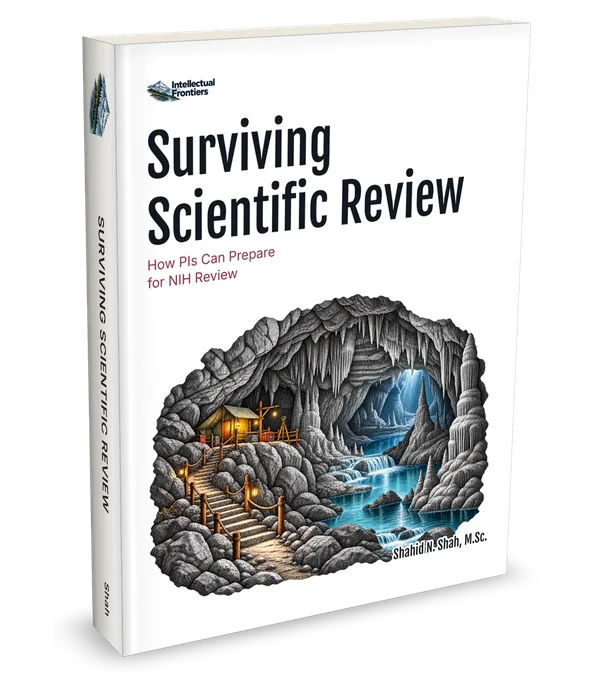
Surviving Scientific Review
How PIs Can Prepare for NIH Review
Prepare hard, understand how the review system works, respect the people who run it, and never confuse preparation with manipulation.
NIH reported 62,592 Research Project Grant applications in fiscal year 2025 and funded about 13 percent of them. Peer review is careful, rule-bound, and about as fair as a system that size can be, but a scientist normally meets it from the outside, a few applications at a time, while NIH and experienced institutions operate with accumulated knowledge most PIs never see.
Forthcoming. The book is in review; its companion and tools are open now.
Good science deserves professional preparation.
Surviving Scientific Review treats that gap as a problem PIs can solve. It teaches PIs to scout the field before they write: understand NIH's rules, study funded analogs, map the review environment, and use public data and AI to prepare the way a professional competitor prepares. It never tries to game or circumvent the process.
The book covers the full arc: choosing the right mechanism and Institute, making the science reviewable, running an internal red team before submission, working with Program Officers, reading a summary statement correctly, and building the institutional memory that makes every future application stronger than the last.
The chapter on institutional memory sketches Aristeion Award Intelligence, a possible AI-native companion built from an auditable Labor as Code skill catalog, and it shows the method in this book can become software. The book stands on its own whether or not it ever does.
A score is an output. Preparation is a controllable input.
What you will be able to do
- scout the review environment before writing a single page;
- choose the mechanism, Institute, and study section your science fits;
- turn preliminary evidence into a proposal reviewers can evaluate;
- run a red team and a mock review before NIH ever sees the application;
- prepare for Program Officer conversations with specific questions;
- read a summary statement for what it says; and
- build institutional memory so the next application starts ahead of this one.
The premise
NIH reported 62,592 Research Project Grant applications in fiscal year 2025 and funded about 13 percent of them. Peer review is careful, rule-bound, and about as fair as a system that size can be, but a scientist normally meets it from the outside, a few applications at a time, while NIH and experienced institutions operate with accumulated knowledge most PIs never see.