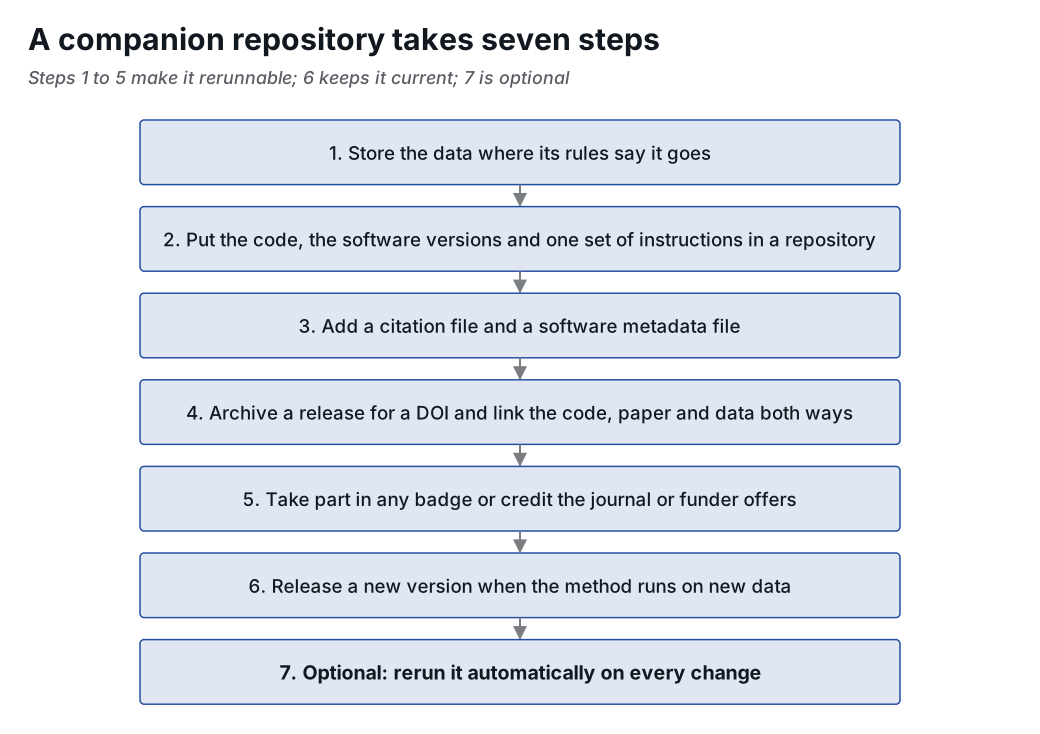
The author checklist in the program's companion turns these steps into a list you can tick off before you submit.
1. Store the data where its rules say
Patient-level data goes to a governed repository such as Vivli or the YODA Project. Data with no patients in it, such as simulations, aggregates or bench measurements, can go in the companion repository itself, versioned with the code.
2. Put the code in a repository
Use GitHub, GitLab or a similar service. Include every script, notebook and spreadsheet that made a result, the exact software versions, and one set of instructions from data to results.
3. Add metadata
Add a CITATION.cff file so people cite it correctly, and a codemeta.json file that describes the software. Both are existing standards; there's no need to invent a format.
4. Link the code, the paper and the data
Archive a release on Zenodo or a similar archive to get a DOI, a permanent address. Put that DOI in the paper, and put the paper's and the data's DOIs in the repository, so each points to the other two.
5. Take part in the recognition on offer
Some journals give badges or featured placement to papers whose code reruns, and some funders give credit for it in review. Whether these raise citations in medicine isn't known, but they do raise sharing.
6. Release new versions as new data arrives
When the method runs on new data, publish a new release with its own DOI. Never change the release the paper cites.
7. Check it automatically, if you can
A continuous integration job, a program that reruns the code on every change, catches breakage early. Rules first, then a model only where rules can't answer, then a person.