
Theory
Versioned releases keep the evidence current while the paper stays fixed
A published paper is a snapshot. A companion repository can keep going: each time the same method runs on new real-world data, the authors publish a new release with its own DOI, and the release the paper cites never changes. Peer review keeps its job, and readers can see whether a finding still holds.
A line of releases keeps testing one finding
Claim: hypothesis
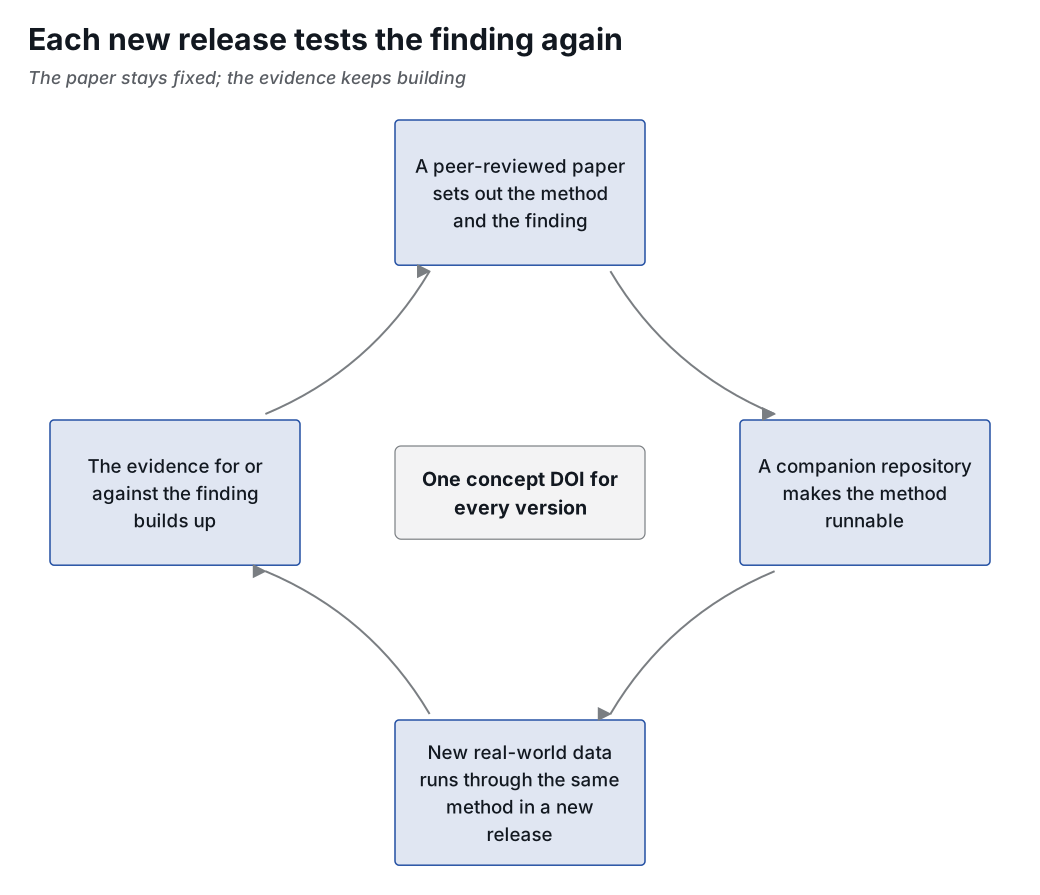
Real-world data is information collected in the ordinary course of care: health records, insurance claims, patient registries, readings from devices such as continuous glucose monitors. Real-world evidence is what an analysis of that data shows. Both keep arriving long after a paper is published.
With a companion repository, the authors, or anyone else, can run the published method on that new data and release the result as a new version. Archives such as Zenodo give each release its own DOI and one concept DOI for the whole line, so a reader always knows which version they're looking at. Version 1.0 is what the reviewers saw; version 3.0 may show that the finding held in a new population, or that it didn't.
What stays the same: peer review judges the paper, the paper is the record of what was found, and the cited release never changes. What gets better: the finding gets tested again, in more people and more settings, and a clinician can see the latest test before acting on it.
What would show this claim is wrong
- Few authors ever publish a second release, so the line of versions doesn't happen.
- Later releases are used by nobody who makes clinical or funding decisions.
- New releases quietly change the method as well as the data, so versions can't be compared.