Books and white papers
The long-form case: an invention explained end to end, a thesis argued with the evidence in order: interoperability programs, device software organizations, trials operations, insurance evidence and authorization.
Intellectual Frontiers Press
An invention nobody understands has no market. Intellectual Frontiers Press exists to make the case for our patents, inventions, ideas, and companies in books, white papers, blog posts, podcasts, and video, so the people who should license, fund, or buy them understand what they are looking at.
Genuinely new work is not self-explanatory. An invention that reasons about insurance appeals, or a device data architecture that assembles its own evidence, means nothing to a hospital CIO or a payer operations chief until someone explains it in terms of their operation. Whether that explanation gets written is usually what decides between an invention that gets adopted and one that sits in a drawer.
So we write it, and we use whatever format the audience actually consumes: a book for the reader who wants the whole argument, a white paper for the evaluator, a blog post for the operator with one question, a podcast or a video for the decision-maker who does not read white papers.
A running thread in the publishing is our question about AI. Most coverage counts hours saved. We argue the harder case in public: which entirely new forms of work become possible in a hospital, a device program, a trial, an authorization workflow, or a marketplace. That argument is part of making the case for the inventions we hold.
The same argument reaches a hospital CIO, a regulatory lead, and a procurement officer in different forms, because they read different things.
The long-form case: an invention explained end to end, a thesis argued with the evidence in order: interoperability programs, device software organizations, trials operations, insurance evidence and authorization.
Timely arguments and dated observations: why a readmission model fails on transfer patients, why a device integration slips two quarters, written so an operator can check the reasoning.
The same ideas in spoken and visual form, for the program lead who will watch twenty minutes but not read forty pages. Complex systems get drawn, walked through, and questioned out loud.
Plain-language readings of the portfolio, so a licensee or procurement officer can judge what a family covers without hiring counsel first.
Every piece argues a position about an invention, a market, or a method, and carries the evidence for it: named systems, dated numbers, and the constraint that made the problem hard. Publishing in the open is how we promote the work and how we stay accountable for it.
That cuts both ways, and we want it to. When a number turns out to be wrong, the correction runs with the same prominence as the original claim. A buyer who catches one honest correction will believe the next ten claims, which is worth more to us than never appearing wrong.
Everything is dated, sourced, and organized by market: clinical workflow, device data, clinical trials, records authorization and insurance evidence, payments and marketplaces, and education and training, so a reader with one question can find the one piece that answers it.
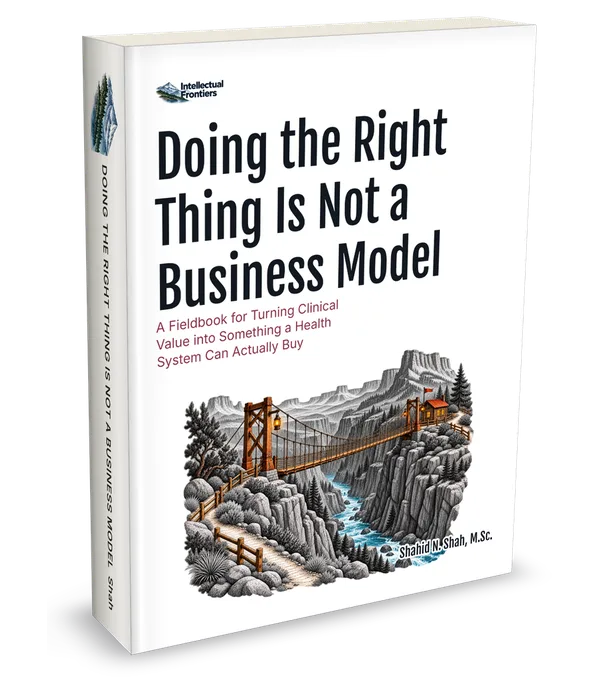
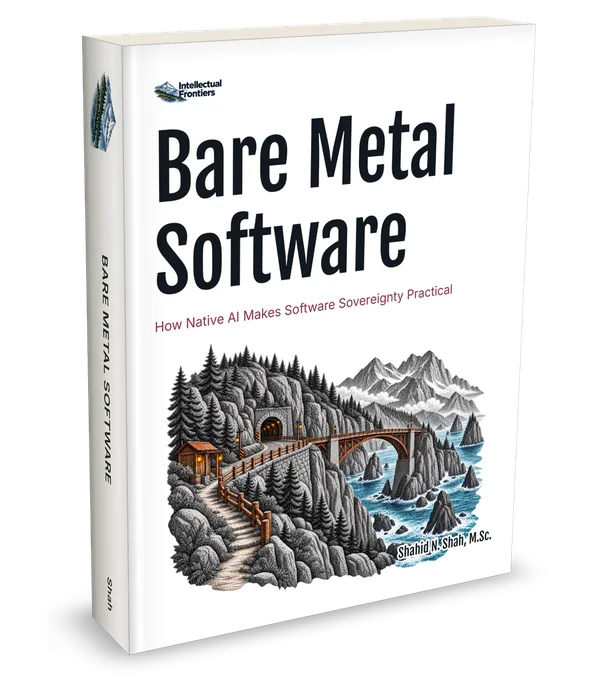
Intellectual Frontiers Press publishes the Shahid Shah Fieldbooks, working manuals for technology leaders rather than commentary about them.
Each title carries one argument with the tools to act on it. Full details live in the portfolio.
A CTO's practical guide to building engineering teams in an AI-first world, argued through the coach's job rather than the best engineer's.
How Native AI makes software sovereignty practical: use the protocol directly when the protocol is simpler than the abstraction around it.
How the best CTOs find the advantage already inside their companies once capability itself is abundant.
A plain-English field guide for founders, CEOs, and boards hiring, working with, and evaluating a technology leader.
We own the channels where our arguments land, so a reader, buyer, or licensee can follow the thread from one invention to the next without a platform's algorithm getting in the way.
Each site below is curated continuously, carries its own audience, and is listed as a substantial work in the portfolio.
The longest continuous record in the program: two decades of health IT arguments, field observations, and invention sketches published in public.
A healthcare media network of news, interviews, and vendor coverage written for the people who buy and run health technology.
A health innovation discovery platform used as an intelligence surface: crowd-curated technology, use cases, and market signal from the field.
GovCon Intelligence Center: how public agencies buy, modernize, and evaluate technology, written for program managers and honest bidders.
The argument that passing an audit is not the same as being secure, written for the people who own both obligations.
The record of what systems actually do versus what they are documented to do, which is where our findings start.
Pick the entry point that matches what you came for: the books, the latest case, one subject, or the portfolio behind it.
The fieldbooks, with contents, frameworks, and status for each title.
Owned channels where our arguments land: HealthcareGuy, HealthcareGuys, Medigy, GovCon IC, CompliantInSecurity, and OperationalTruth.
Working theories, design patterns, contrarian briefs, and practitioner journalism published on shahidshah.com, listed here as it appears.
Every book, research program, publication, and summary series we publish, listed alongside what it argues for.
Our arguments and evidence, in the order we published them.
The same body of work grouped by market and problem, for readers with one question.
What each invention covers, written for operators rather than examiners.
Review copies, interviews, speaking requests, citations, and corrections.